Short-Haul Flying Redefined: The Promise of Regional Air Mobility↗
Highlights
More than 50 companies are developing battery-electric, hybrid, and hydrogen powertrains; new and retrofitted aircraft designs; advanced avionics; operations and booking platforms; and other important enablers of the RAM ecosystem. More than $1 billion has been invested in these RAM start-ups to date and the first retrofitted aircraft are slated to enter service in the mid-2020s. Simultaneously, an ecosystem of operators, consisting mainly of established airlines and regionally focused start-ups, is coming together to drive the industry forward.
Airlines have gradually shifted toward bigger aircraft and have consolidated operations at larger airports. A shortage of pilots has also contributed to the phaseout of small regional aircraft from airline operations.
In tandem with the decline in regional traffic, production of small aircraft has slowed, with the exception of private aircraft. Deliveries of passenger aircraft with six to 50 seats (for commercial, non-scheduled, and business or private use) peaked at about 1,500 in 2008. While the global fleet of six- to 50-seat passenger aircraft grew from 21,500 aircraft in 1990 to 41,400 in 2022, the growth was exclusively driven by business or private aircraft. Excluding business or private aircraft, the fleet has declined from 6,100 aircraft in 2008 to 4,100 today. New deliveries averaged 1,000 aircraft per year from 2016 through 2022, of which 98 percent were business or private aircraft.6Cirium fleets analyzer database, March 20, 2023; includes commercial regional jets and turboprops, non-scheduled aircraft, and business or private aircraft. The decline in production, combined with the increasing age of the small regional fleet, may compel regional operators to invest in green propulsion aircraft rather than extending the life of existing aircraft.
Although the regional market has declined, key infrastructure remains. There are thousands of regional airports worldwide, most of them underutilized. In Europe, 50 percent of people live within a 30-minute drive of a regional airport, compared with 40 percent for a commercial airport. In the United States, 90 percent of people live within a 30-minute drive of a regional airport, compared with 60 percent for a commercial airport.
Governments and the public are increasingly focused on sustainability; their concerns will help shape the future of the aviation industry, which is responsible for approximately 4 percent of anthropogenic global warming.
One-third of travelers rank emissions as their number one aviation concern, ahead of others such as noise pollution and excess tourism, and over 25 percent are willing to pay at least 5 percent more for carbon-neutral tickets.
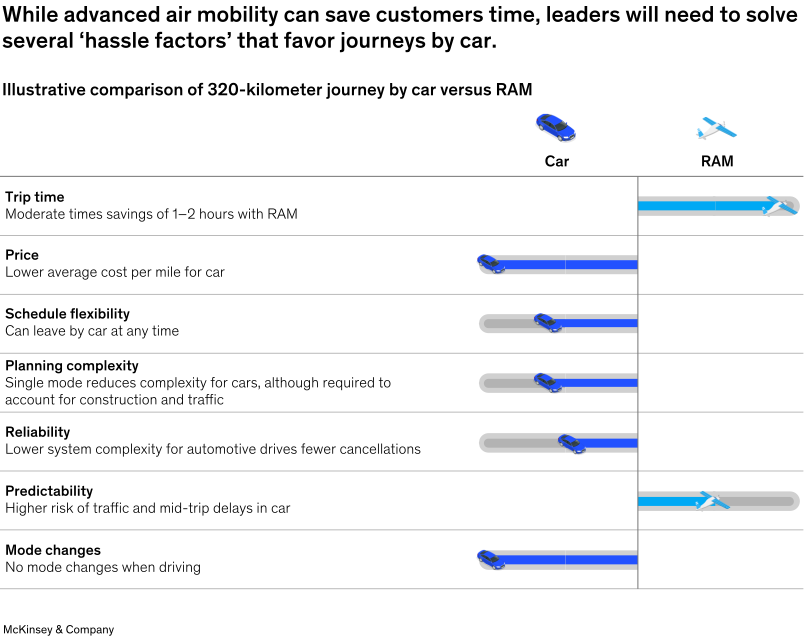
The priority for most travelers is to get from point A to B quickly and easily. But on the road, the typical driver in the United States loses 51 hours annually due to congestion; in the United Kingdom, drivers lose 80 hours annually. In 39 percent of US metro areas and 42 percent of European metro areas, traffic was worse in 2022 than it was before the COVID-19 pandemic.
More than 200 major airports worldwide—handling 43 percent of the world’s passengers—are capacity constrained and routinely limit landing slots.20“Fact sheet: Worldwide airport slots,” November 2022. These factors, exacerbated by the consolidation of flights at major hubs, make for a frustrating and delay-prone travel experience. These trends underscore the unmet demand for a fast transportation mode that avoids congested roads and major airports.
More than 50 companies are developing battery-electric, hybrid, or hydrogen aircraft, or powertrains for retrofit, with 2025 seen as the earliest potential date for entry into service. Companies that are developing powertrains include Ampaire, MagniX, Pratt & Whitney, Rolls-Royce Electric, VerdeGo, and ZeroAvia. Other players are working on new aircraft designs using those technologies, including Airbus, Electra.aero, Embraer, Eviation, and Heart Aerospace.
Our modeling suggests a TAM for RAM passenger revenue of $75 billion to $115 billion by 2035 (Exhibit 2).22Global passenger RAM market defined as flights for point-to-point trips of 150 to 800 kilometers operated by five- to 50-seat aircraft. This includes $40 billion to $65 billion from travelers switching away from ground or marine travel, $18 billion to $20 billion from passengers who take RAM flights instead of commercial flights on larger aircraft, and $12 billion to $25 billion from stimulated demand—that is, travelers taking trips they would not otherwise have taken, due to the convenience and availability of RAM. Our estimate of TAM includes roughly $5 billion in revenue for existing point-to-point flights 150 to 800 kilometers in length, operated by aircraft with five to 50 seats.
Our model assumes that demand for travel will increase in line with historical growth and that travelers will switch to RAM from ground or marine travel, or from commercial air travel on larger aircraft, if the economics and time savings merit it.
For the RAM market to reach its full potential, we expect 18,000 new or retrofitted RAM aircraft will be required by 2035 in the low-end scenario and 36,000 in the high-end scenario.
Battery energy density will need to at least double today’s density for the RAM market to meet its full potential. Similarly, hydrogen fuel cells are at an early stage of maturity and further advances will be critical to RAM’s growth.
To fuel hydrogen planes, the typical airport will need 500 to 1,500 tons of hydrogen annually. The cost of green hydrogen fuel—which must be from low- or zero-emissions sources—will need to fall significantly for the economics to work. Additionally, hydrogen must be produced in sufficient volumes to serve the market globally.