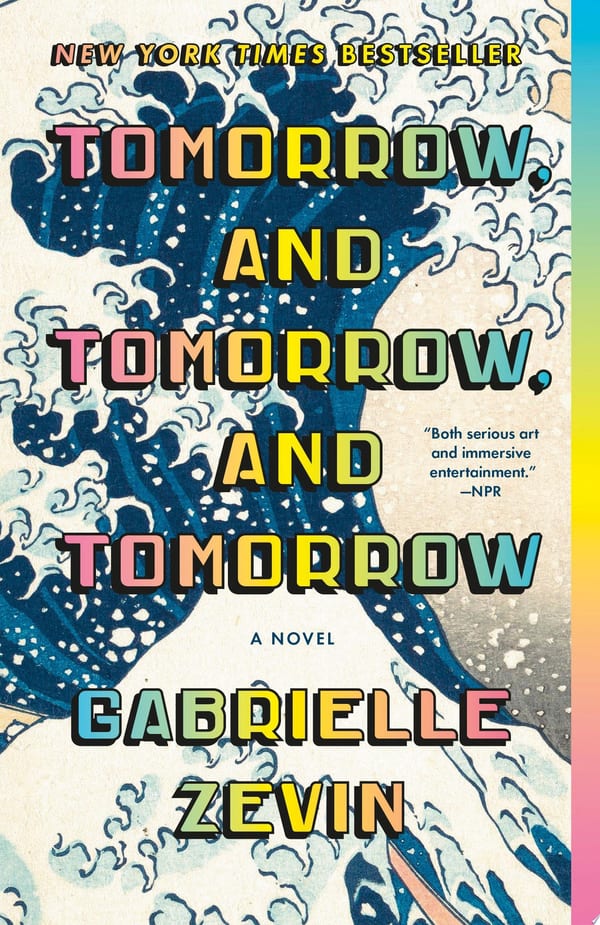
Tomorrow, and Tomorrow, and Tomorrow
About
NEW YORK TIMES BESTSELLER • Sam and Sadie—two college friends, often in love, but never lovers—become creative partners in a dazzling and intricately imagined world of video game design, where success brings them fame, joy, tragedy, duplicity, and, ultimately, a kind of immortality. It is a love story, but not one you have read before. “Delightful and absorbing.” —The New York Times • “Utterly brilliant.” —John Green One of the New York Times’s 100 Best Books of the 21st Century • A Kirkus Reviews Best Fiction Book of the Century • A Los Angeles Times Best Fiction Book of the Last 30 Years • One of the Best Books of the Year: The New York Times, Entertainment Weekly, TIME, GoodReads, Oprah Daily From the best-selling author of The Storied Life of A. J. Fikry: On a bitter-cold day, in the December of his junior year at Harvard, Sam Masur exits a subway car and sees, amid the hordes of people waiting on the platform, Sadie Green. He calls her name. For a moment, she pretends she hasn’t heard him, but then, she turns, and a game begins: a legendary collaboration that will launch them to stardom. These friends, intimates since childhood, borrow money, beg favors, and, before even graduating college, they have created their first blockbuster, Ichigo. Overnight, the world is theirs. Not even twenty-five years old, Sam and Sadie are brilliant, successful, and rich, but these qualities won’t protect them from their own creative ambitions or the betrayals of their hearts. Spanning thirty years, from Cambridge, Massachusetts, to Venice Beach, California, and lands in between and far beyond, Gabrielle Zevin’s Tomorrow, and Tomorrow, and Tomorrow examines the multifarious nature of identity, disability, failure, the redemptive possibilities in play, and above all, our need to connect: to be loved and to love.
Unchaptered
p. 7
How many times can you look at something and know that everyone around you is seeing the same thing or at the very least that their brains and eyes are responding to the same phenomenon? How much proof do you ever have that we’re all in the same world?
p. 11
“…it is worth noting that to be good at something is not quite the same as loving it.”
p. 21
To allow yourself to play with another person is no small risk. It means allowing yourself to be open, to be exposed, to be hurt. It is the human equivalent of the dog rolling on its back—I know you won’t hurt me, even though you can.
p. 22
To design a game is to imagine the person who will eventually play it.
p. 65
How do you preserve the impossible to preserve? Or, in other words, how do you stop time and death?
p. 65
The way he saw it, he would be proposing to Sadie. He would be getting down on one knee and saying, “Will you work with me? Will you give me your time, and will you trust my hunch that this time will be well spent? Will you believe that we could make great things together?“
p. 65
But this was classic Sam—he had learned to tolerate the sometimes-painful present by living in the future.
p. 68
She could tell you exactly what was wrong with any game, but she didn’t necessarily know how to make a great game herself. There is a time for any fledgling artist where one’s taste exceeds one’s abilities. The only way to get through this period is to make things anyway.
p. 69
The key to being a good thief, Sam always felt, was utter brazenness.
p. 69
“Why make anything if you don’t believe it could be great?“
p. 70
“Sometimes, I would be in so much pain. The only thing that kept me from wanting to die was the fact that I could leave my body and be in a body that worked perfectly for a while—better than perfectly, actually—with a set of problems that were not my own.”
p. 76
…the key to making a video game on limited resources was to make the limitations part of the style.
p. 82
“…that is the truth of any game—it can only exist at the moment that it is being played. It’s the same with being an actor. In the end, all we can ever know is the game that was played, in the only world that we know.”
p. 92
Marx’s favorite adjective was “interesting.” The world seemed filled with interesting books to read, interesting plays and movies to see, interesting games to play, interesting food to taste, and interesting people to have sex with and sometimes even to fall in love with.
p. 97
Sam’s grandfather had two core beliefs: (1) all things were knowable by anyone, and (2) anything was fixable if you took the time to figure out what was broken.
p. 103
There was a pleasant Weltschmerz that came over him. It was the nostalgia one experienced when visiting an old school and finding that the desks were so much smaller than in one’s memory.
p. 118
They are not only my friends. They are my colleagues. He had turned them into his colleagues, and in a strange way, that was comforting to Sam. Ichigo bonded them to him for life.
p. 156
She was intelligent, but her intelligence didn’t get in the way of her enthusiasm.
p. 161
“The key to getting what you want in a hospital is telling the right lies in an authoritative voice.”
p. 217
She felt, perhaps, old. She was still only twenty-five, but until that point, she had always been the youngest in any room she’d been in, and she had derived power from that.
p. 227
“It isn’t a sadness, but a joy, that we don’t do the same things for the length of our lives.”
p. 230
“Computers are great for experimentation, but they’re bad for deep thinking.”
p. 234
Sadie had often reflected that sex and video games had a great deal in common. There were certain objectives that needed to be met. There were certain rules that shouldn’t be broken. There was a correct combination of movements—button mashes, joystick pivots, keystrokes, commands—that made the whole thing work or not work. There was a pleasure to knowing you had played the game correctly and a release that came when you reached the next level. To be good at sex was to be good at the game of sex.
p. 247
“The most successful people are also the most able to change their mindsets.”
p. 286
Memory, you realized long ago, is a game that a healthy-brained person can play all the time, and the game of memory is won or lost on one criterion: Do you leave the formation of memories to happenstance, or do you decide to remember?
p. 299
A name is destiny, if you think it is.
p. 301
The way to turn an ex-lover into a friend is to never stop loving them, to know that when one phase of a relationship ends it can transform into something else. It is to acknowledge that love is both a constant and a variable at the same time.
p. 331
“I love that [video game] world more, I think, because it is perfectible. Because I have perfected it. The actual world is the random garbage fire it always is. There’s not a goddamn thing I can do about the actual world’s code.”
p. 336
“What is a game?” Marx said. “It’s tomorrow, and tomorrow, and tomorrow. It’s the possibility of infinite rebirth, infinite redemption. The idea that if you keep playing, you could win. No loss is permanent, because nothing is permanent, ever.”
p. 344
“I suppose we drink and we smoke for the same reasons it is done elsewhere. We must fill our infinite days with something.”
p. 351
“A programmer is a diviner of possible outcomes, and a seer of unseen worlds.”
p. 355
“To make a game is to imagine the person playing it.”
p. 369
At a certain age—in Sadie’s case, thirty-four—there comes a time when life largely consists of having meals with old friends who are passing through town.
p. 374
“To build a world for someone seems a romantic thing from where I stand.”
p. 376
“…when you don’t have many resources, you have to be even more rigorous with your style. Limitations are style if you make them so.”
p. 376
“If you’re always aiming for perfection, you won’t make anything at all.”
p. 378
How to explain to Destiny that the thing that made her work leap forward in 1996 was that she had been a dervish of selfishness, resentment, and insecurity? Sadie had willed herself to be great: art doesn’t typically get made by happy people.
p. 382
The best you can wish for anyone, Sam decided, is a video game death. Which is to say, spectacular and brief.
p. 387
Maybe it was the willingness to play that hinted at a tender, eternally newborn part in all humans. Maybe it was the willingness to play that kept one from despair.
p. 388
Sadie had invented a game where if Naomi called bedtime before Sadie did for seven nights in a row, Naomi received a prize. Yes, it was manipulative and basically bribery, but it was also effective at getting her five-year-old to bed.
p. 393
“Lovers are… common.” She studied Sam’s face. “Because I loved working with you better than I liked the idea of making love to you. Because true collaborators in this life are rare.”
p. 394
“This generation doesn’t hide anything from anyone. My class talks a lot about their traumas. And how their traumas inform their games. They, honest to God, think their traumas are the most interesting thing about them. I sound like I’m making fun, and I am a little, but I don’t mean to be. They’re so different from us, really. Their standards are higher; they call bullshit on so much of the sexism and racism that I, at least, just lived with. But that’s also made them kind of, well, humorless.”
p. 396
“You couldn’t be old and still be wrong about as many things as she’d been wrong about, and it was a kind of immaturity to call yourself old before you were.”
“What’s Torschlusspanik?” Sam said.
She realized what a gate was: it was an indication that you had left one space and were entering another…
A truly magnificent thing about the way the brain was coded, Sam thought, was that it could say “Excuse me” while meaning “Screw you.”
“The alternative to appropriation is a world where white European people make art about white European people, with only white European references in it… A world where everyone is blind and deaf to any culture or experience that is not their own.
“Hi,” Sam said, without looking at her. “You can watch if you want. I’m going to play until the end of this life.”
He had spent his childhood among rich and supposedly interesting people, and he knew that truly unusual minds were rare…
Highlights
“What’s Torschlusspanik?” Sam said.
“It means ‘gate-shut panic,’” Simon said. “It’s the fear that time is running out and that you’re going to miss an opportunity. Literally, the gate is closing, and you’ll never get in.”