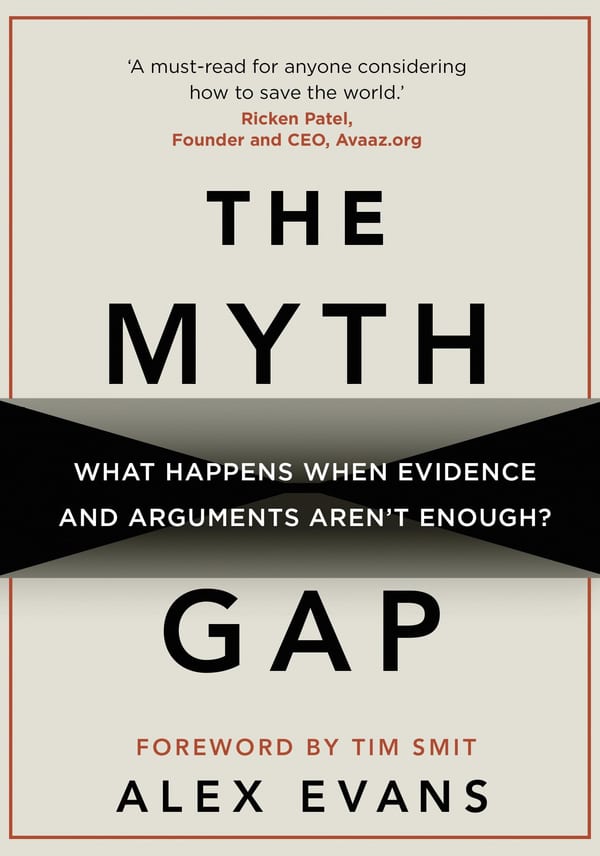
The Myth Gap: What Happens When Evidence and Arguments Aren't Enough
About
Why, with absolutely no idea what Brexit actually meant, did the UK vote for Brexit? Why, rather than vote for the best-qualified candidate ever to stand as US President, did voters opt for a reality TV star with no political experience? In both cases, the winning side promised change and offered hope. They told a story voters longed to hear. And in the absence of greater, more unifying narratives, then true or not, voters plumped for the best story available. Once upon a time our society was rich in stories. They brought us together and helped us to understand the world and ourselves. We called them myths. Today, we have a myth gap – a vacuum that Alex Evans argues powerfully and persuasively is both dangerous and an opportunity. In this time of global crisis and transition– mass migration, inequality, resource scarcity, and climate change - It is stories, rather than facts and pie-charts,that will animate us and bring us together. It is by finding new myths, those that speak to us of renewal and restoration, that we will navigate our way to a better future.
Drawing on his first-hand experience as a political adviser within British government and at the United Nations, and examining the history of climate change campaigning and recent contests such as Brexit and the US presidential election, Alex Evans explores: *how tomorrow’s activists are using narratives for change,
- how modern stories have been used and abused,
- where we might find the right myths that will take us forward
Unchaptered
p. 0
The Myth Gap points to a truth that we all must learn: that something big, something that could change the world into a much better place, can emerge from the marriage of millions of small things, connecting, weaving in and out with a natural pattern, giving meaning to the whole.
p. 7
National polls tell enviros what they want to hear: in the abstract, majorities always support clean air and clean energy. Enviros mistook these results for constituencies. But poll results do not attend town halls or write members of Congress or exhort their fellow citizens through ideological media. Constituencies do that.
p. 11
The Myth Gap points to a truth we all must learn: that something big, something that could change the world into a much better place, can emerge from the marriage of millions of things, connecting, weaving in and out with a natural pattern, giving meaning to the whole.
p. 12
When it comes to how we make up our minds about political issues, it turns out that evidence, facts, and data matter much less than the values held by the people we hang out with: family, friends, colleagues.
p. 12
When it comes to how we make up our minds about political issues, it turns out that evidence, facts and data matter much less than the values held by the people we hang out with: family, friends, colleagues.
p. 13
… if you’re playing a long game, as the climate activists now are, and you want to keep the pressure up over time, then small groups are the glue that holds everything together.
p. 21
In the pre-modern world, as historian of religion Karen Armstrong puts it, ‘mythology not only helped people to make sense of their lives but also revealed regions of the human mind that would otherwise have remained inaccessible.’ In other words, she continues, it was an early form of psychology: when our ancestors told each other tales of gods and heroes, labyrinths and monsters, they ‘brought to light the mysterious workings of the psyche, showing people how to cope with their own interior crises.‘
p. 32
… the fear of resource scarcity—the belief that there isn’t enough food or land to meet everyone’s needs, and hence that there’s no choice to grab it and if necessary fight for it—provides the perfect soil in which fascism can germinate.
p. 107
…mindfulness is a form of training that empowers practitioners to make decisions about how to respond to events rather than just acting reflexively, to practise discernment, and to see reality in a more considered, less reactive way.
p. 110
The single trait that we most want to see in our leaders (and most often find lacking) is authenticity—and unless we’re willing to bring the personal into the conversation, we will almost always lack it ourselves.