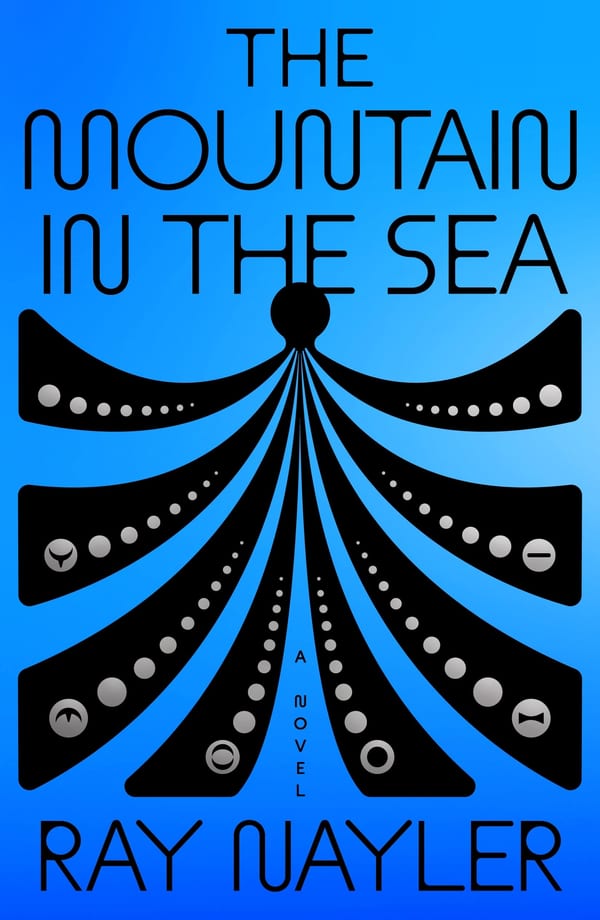
The Mountain in the Sea
About
*WINNER OF 2023 LOCUS AWARD FOR BEST FIRST NOVEL * FINALIST FOR THE NEBULA AWARD, and THE LOS ANGELES TIMES RAY BRADBURY PRIZE
“The Mountain in the Sea is a wildly original, gorgeously written, unputdownable gem of a novel. Ray Nayler is one of the most exciting new voices I’ve read in years.” —Blake Crouch, author of Upgrade and Dark Matter
Humankind discovers intelligent life in an octopus species with its own language and culture, and sets off a high-stakes global competition to dominate the future.
The transnational tech corporation DIANIMA has sealed off the remote Con Dao Archipelago, where a species of octopus has been discovered that may have developed its own language and culture. The marine biologist Dr. Ha Nguyen, who has spent her life researching cephalopod intelligence, will do anything for the chance to study them. She travels to the islands to join DIANIMA’s team: a battle-scarred securityagent and the world’s first (and possibly last) android.
The octopuses hold the key to unprecedented breakthroughs in extrahuman intelligence. As Dr. Nguyen struggles to communicate with the newly discovered species, forces larger than DIANIMA close in to seize the octopuses for themselves.
But no one has yet asked the octopuses what they think. Or what they might do about it.
A near-future thriller, a meditation on the nature of consciousness, and an eco-logical call to arms, Ray Nayler’s dazzling literary debut The Mountain in the Sea is a mind-blowing dive into the treasure and wreckage of humankind’s legacy.
Unchaptered
p. 11
We come from the ocean, and we only survive by carrying salt water with us all our lives—in our blood, in our cells. The sea is our true home. This is why we find the shore so calming: we stand where the waves break, like exiles returning home.
p. 23
We understand the encoding of genetic sequences, the folding of proteins to construct the cells of the body, and even a good deal about how epigenetic switches control these processes. And yet we still do not understand what happens when we read a sentence. Meaning is not neuronal calculus in the brain, or the careful smudges of ink on a page, or the areas of light and dark on a screen. Meaning has no mass or charge. It occupies no space—and yet meaning makes a difference in the world.
p. 42
I remember Dr. Mínervudóttir-Chan saying she couldn’t tell whether they were a nation-state, a religion, or a corporation—but that they certainly known how to operate like all three, using whichever rules and laws are convenient to get their way.
p. 54
In an aquarium, it’s often only the dolphins, otters, and octopuses that get named by volunteers. Two mammals, which is understandable, as they are species relatively close to our own—and a cephalopod, a species so different from us that our last common ancestor was five hundred million years ago. Why? People name octopuses because, no matter how different they are from us, we recognize something in them. Something we have in common.
p. 75
Communication is not what sets humans apart. All life communicates, and at a level sufficient to its survival. Animal and even plant communications are, in fact, highly sophisticated. But what makes humans different is symbols—letters and words that can be arranged in the self-referential sets we call language. Using symbols, we can detach communication from its direct relation to things present around us. We can speak with one another about things not here and now. We can tell stories. Tradition, myth, history, culture—these are storage systems for knowledge, and they are all products of the symbol. And the use of symbols is something we have not seen outside our own species.
p. 176
This was what talking to Kamran did for her: allowed her to sort her thoughts, prepare for her interactions with others. Without him, her thoughts were circular, insular. He helped her shape and control them, gave her new input, allowed her to modulate her output. To translate it, make it understandable to others.
p. 183
Death is a part of us. It shapes our bodies from the very beginning. You might think your fingers are formed by the division of cells in the womb—but that is not the case. Fingers are chiseled out of a paddle of flesh by the death of cells, the same way David was chiseled by his sculptor from a block of marble. Without death, life would have no shape at all.
p. 185
No matter how good you are, you can only be as good as the data you are given. The input. If something essential is missing, if the input is off from the start, there’s no solving the problem.
p. 220
…it’s about more than that: it’s intelligence is strongly attached to curiosity and exploration. And one of the most intriguing things about the octopus is that much of that curiosity may, in fact, reside in its arms.
p. 245
That’s what we are, we humans—creatures that can forget. We have a horizon, beyond which we can remember very little. Nothing can reside in our minds forever, etched into us. No resentment, and no joy. Time rubs it away. Sleep rubs it away—sleep, the factory of forgetting. And through forgetting, we reorganize our world, replace our old selves with new ones.
p. 266
“We are so ashamed of what we have done as a species that we have made up a monster to destroy ourselves with. We aren’t afraid it will happen: We hope it will. We long for it. Someone needs to make us pay the price for what we have done. Someone needs to take this planet away from us before we destroy it once and for all. And if the robots don’t rise up, if our creations don’t come to life and take the power we have used so badly for so long away from us, who will? What we fear isn’t that AI will destroy us—we fear it won’t. We fear we will continue to degrade life on this planet until we destroy ourselves. And we will have no one to blame for what we have done but ourselves. So we invent this nonsense about conscious AI.”
Every octopus we encounter has survived adventures and trials unimaginable to us. The octopus who has lived to adulthood in the dangers of the sea will be an Odysseus, a “man of twists and turns,” a heroically clever artist of battle and escape. How many arms will it have lost and regrown? How many forms will it have taken on to hide and stalk its prey? How many deaths will it have escaped?
The is no silence in the living nervous system. An electrical symphony of communication streams through our neurons every moment we exist. We are built for communication.
…it felt as if she were about to dive off the end of the earth, into another world. This was the way she always felt before diving, especially if she had been away from it…
In the octopus we see opportunism, exploration, creativity—the qualities we associate with consciousness in our own mental life. We think we recognize a mind like our own.
This was why the world would never build another humanoid AI. The smile was perfect. Sincere, unaffected. Full human.
It is not just the symbols we use in our language that are arbitrary—it is what we choose to signify with them.
When the brain stores long-term memory, it changes the memory from activity to structured connections. Imagine it like this: You are trying to remember a phone number. At first you have nowhere to write it out. So you say it to yourself, over and over. That is activity. Then you find a terminal and write the phone number out, converting activity to physical structure.
When we avoid behaviors that would instigate a shark attack, we are recognizing the shark has a mind capable of reading our signs and responding to them. Like it or not, we are in communication with them. If we accidentally send out signs to a shark that indicate we are prey (if we look too much like a seal in our wet suit, or we produce vibrations in the water like a fish in distress), we know we may instigate an attack, despite the fact that the shark does not typically prey on humans. We can cause the shark to misinterpret the world’s signs and make a mistake—a mistake which may be fatal to us.