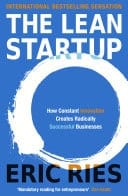
'The Lean Startup: How Today''s Entrepreneurs Use Continuous Innovation to
About
THE INTERNATIONAL BESTSELLING SENSATION
‘The Lean Startup changes everything.’ - Harvard Business Review
Most new businesses fail. But most of those failures are preventable.
The Lean Startup is a new approach to business that’s being adopted around the world. It is changing the way companies are built and new products are launched.
Essential reading for any ambitious entrepreneur, The Lean Startup will teach you to identify what your customers really want. You’ll learn how to test your vision continuously, adapting and adjusting before it’s too late.
With over a million copies sold across the globe, now is your time to think Lean.
Unchaptered
p. 3
…it’s the boring stuff that matters the most. Startup success is not a consequence of good genes or being in the right place at the right time. Startup success can be engineered by following the right process, which means it can be learned, which means it can be taught.
p. 33
…when you have only one test, you don’t have entrepreneurs, you have politicians, because you have to sell… When you have five hundred tests you’re running, then everybody’s ideas can run. And then you create entrepreneurs who run and learn and can retest and relearn as opposed to a society of politicians.
p. 41
As launch day approached, our fears escalated. In our situation, many entrepreneurial teams give in to fear and postpone the launch date. Although I understand this impulse, I am glad we persevered, since delay prevents many startups from getting the feedback they need.
p. 51
It is also the right way to think about productivity in a startup: not in terms of how much stuff we are building but in terms of how much validated learning we’re getting for our efforts.
p. 52
The irony is that it is often easier to raise money or acquire other resources when you have zero revenue, zero customers, and zero traction than when you have a small amount. Zero invites imagination, but small numbers invite questions about whether large numbers will ever materialize.
p. 55
…learn to see every startup in any industry as a grand experiment. The question is not “Can this product be built?” In the modern economy, almost any product that can be imagined can be built. The more pertinent questions are “Should this product be built?” and “Can we build a sustainable business around this set of products and services?“
p. 56
Unfortunately, if the plan is to see what happens, a team is guaranteed to succeed—at seeing what happens—but won’t necessarily gain validated learning. This is one of the most important lessons of the scientific method: if you cannot fail, you cannot learn.
p. 86
You cannot be sure you really understand any part of any business problem unless you go and see for yourself firsthand. It is unacceptable to take anything for granted or to rely on the reports of others.
p. 149
…there is no bigger destroyer of creative potential than the misguided decision to persevere.
p. 227
This is one of the most important discoveries of the lean manufacturing movement: you cannot trade quality for time. If you are causing (or missing) quality problems now, the resulting defects will slow you down later.
p. 234
Although it’s human nature to assume that when we see a mistake, it’s due to defects in someone else’s department, knowledge, or character, the goal of the Five Whys is to help us see the objective truth that chronic problems are caused by bad process, not bad people, and remedy them accordingly.
Highlights
We often lose sight of the fact that a startup is not just about a product, a technological breakthrough, or even a brilliant idea. A startup is greater than the sum of its parts; it is an acutely human enterprise.
Validated learning is not after-the-fact rationalization or a good story designed to hide failure. It is a rigorous method for demonstrating progress when one is embedded in the soil of extreme uncertainty in which startups grow. Validated learning is the process of demonstrating empirically that a team has discovered valuable truths about a startup’s present and future business prospects.