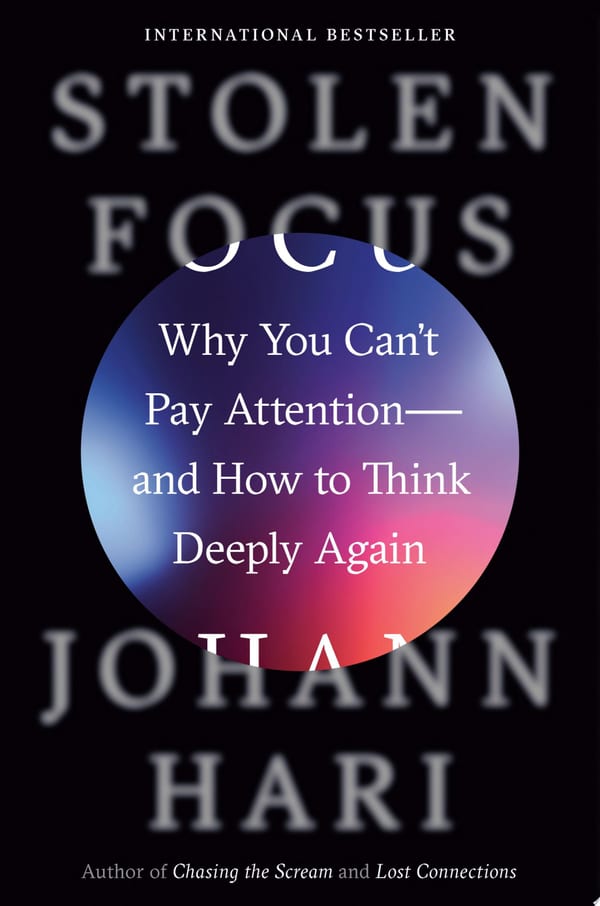
Stolen Focus
About
NEW YORK TIMES BESTSELLER • Our ability to pay attention is collapsing. From the author of Chasing the Scream and Lost Connections comes a groundbreaking examination of why this is happening—and how to get our attention back.
“The book the world needs in order to win the war on distraction.”—Adam Grant, author of Think Again
“Read this book to save your mind.”—Susan Cain, author of Quiet WINNER OF THE PORCHLIGHT BUSINESS BOOK AWARD • ONE OF THE BEST BOOKS OF THE YEAR: The Wall Street Journal, Financial Times, New York Post, Mashable, Mindful
In the United States, teenagers can focus on one task for only sixty-five seconds at a time, and office workers average only three minutes. Like so many of us, Johann Hari was finding that constantly switching from device to device and tab to tab was a diminishing and depressing way to live. He tried all sorts of self-help solutions—even abandoning his phone for three months—but nothing seemed to work. So Hari went on an epic journey across the world to interview the leading experts on human attention—and he discovered that everything we think we know about this crisis is wrong. We think our inability to focus is a personal failure to exert enough willpower over our devices. The truth is even more disturbing: our focus has been stolen by powerful external forces that have left us uniquely vulnerable to corporations determined to raid our attention for profit. Hari found that there are twelve deep causes of this crisis, from the decline of mind-wandering to rising pollution, all of which have robbed some of our attention. In Stolen Focus, he introduces readers to Silicon Valley dissidents who learned to hack human attention, and veterinarians who diagnose dogs with ADHD. He explores a favela in Rio de Janeiro where everyone lost their attention in a particularly surreal way, and an office in New Zealand that discovered a remarkable technique to restore workers’ productivity. Crucially, Hari learned how we can reclaim our focus—as individuals, and as a society—if we are determined to fight for it. Stolen Focus will transform the debate about attention and finally show us how to get it back.
Unchaptered
p. 7
I strode up to Adam and snatched his phone from his grasp. “We can’t live like this!” I said. “You don’t know how to be present! you are missing your life! You’re afraid of missing out—that’s why you are checking your screen all the time! By doing that, you are guaranteeing you are missing out! You are missing your one and only life! You can’t see the things that are right in front of you, the things you have been longing to see since you were a little boy!“
p. 13
A study by Professor Michael Posner at the University of Oregon found that if you are focusing on something you get interrupted, on average it will take twenty-three minutes for you to get back to the same state of focus. A different study of office workers in the U.S. found most of them never get an hour of uninterrupted work in a typical day. If this goes on for months and years, it scrambles your ability to figure out who you are and what you want. You become lost in your own life.
p. 22
…pre-commitment was strikingly successful—resolving clearly to do something, and making the pledge that they’d stick to it, made the men significantly better at holding out.
p. 32
We are soaked in information… In 1986, if you added up all the information being blasted at the average human being—TV, radio, reading—it amounted to 40 newspapers’ worth of information every day. By 2007, they found it had risen to the equivalent of 174 newspapers per day… The increase in the volume of information is what creates the sensation of the world speeding up.
p. 33
[Sune Lehmann] said, “what we are sacrificing is depth in all sorts of dimensions… Depth takes time. And depth takes reflection. If you have to keep up with everything and send emails all the time, there’s ==no time== to reach depth. Depth connected to your work in relationships also takes time. It takes energy. It takes long time spans. And it takes commitment. It takes attention, right? All of those things that require depth are suffering. It’s pulling us more and more up onto the surface.”
p. 34
…we are headed for a world where “there’s going to be an upper class of people that are very aware” of the risks to their attention and find ways to live within their limits, and then there will be the rest of the society with “fewer resources to resist the manipulation, and they’ve going to be living more and more inside their computers, being manipulated more and more.”
p. 35
When I read a physical newspaper, I’ll often be drawn to the stories that I don’t understand yet… But when I read the same newspaper online, I usually skim those stories, and click on the simpler, more scannable stories related to the stuff I already know. After I noticed this, I wondered if in some ways we are increasingly speed-reading life, skimming hurriedly from one thing to another, absorbing less and less.
p. 35
There’s evidence that a broad range of important factors in our lives really are speeding up: people talk significantly faster now than they did in the 1950s, and in just twenty years, people have started to walk 10 percent faster in cities
p. 36
…“we have to shrink the world to fit our cognitive bandwidth.” If you go too fast, you overload your abilities, and they degrade. But when you practice moving at a speed that is compatible with human nature—you begin to train your attention and focus… Slowness, he explained, nurtures attention, and speed shatters it.
p. 37
“Your brain can only produce one or two thoughts,” in your conscious mind at once. That’s it. “We’re very, very single-minded.” We have “very limited cognitive capacity.”
p. 39
The study found that “technological distraction”—just getting emails and calls—caused a drop in the workers’ IQ by an average of ten points. To give you a sense of how big that is: in the short term, that’s twice the knock to your IQ that you get when you smoke cannabis.
p. 40
This [diminished memory effect] seems to be because it takes mental space and energy to convert your experiences into memories, and if you are spending your energy instead on switching very fast, you’ll remember and learn less.
p. 40
Then there’s a third cost to believing you can multitask… You’re likely to be significantly less creative… Your mind, given free undistracted time, will automatically think back over everything it absorbed, and it will start to draw links between them in new ways.
p. 41
The students who received [text messages during the test] performed, on average, 20 percent worse. Other studies in similar scenarios have found even worse outcomes of 30 percent. It seems to me that almost all of us with a smartphone are losing that 20 to 30 percent, almost all the time.
p. 48
Narcissism, it occurred to me, is a corruption of attention—it’s where your attention becomes turned in only on yourself and your own ego.
p. 49
…if you have spent long enough being interrupted in your daily life, you will start to interrupt yourself even when you are set free from all these external interruptions.
p. 55
[Mihaly Csikszentmihalyi] called it a “flow state.” This is when you are so absorbed in what you are doing that you lose all sense of yourself, and time seems to fall away, and you are flowing into the experience itself. It is the deepest form of focus and attention that we know of.
p. 56
So, to find flow, you need to choose one single goal; make sure your goal is meaningful to you; and try to push yourself to the edge of your abilities.
p. 57
…flow states are a real and deep form of human attention. [Scientists] have also shown that the more flow you experience, the better you feel.
p. 60
I noticed that if I spent a day where I experience three hours of flow early on, for the rest of the day, I felt relaxed and open and able to engage—to walk along the beach, or start chatting to people, or read a book, without feeling cramped, or irritable, or phone-hungry.
p. 62
…we all have a choice now between two profound forces—fragmentation, or flow. Fragmentation makes you smaller, shallower, angrier. Flow makes you bigger, deeper, calmer. Fragmentation shrinks us. Flow expands us.
p. 66
In fact, if you stay awake for nineteen hours straight, you become as cognitively impaired—as unable to focus and think clearly—as if you had gotten drunk.
p. 67
The effects of sleep deprivation, Charles found, are especially terrible for children. Adults usually respond by becoming drowsy, but kids usually respond by becoming hyperactive.
p. 68
…on average, a typical student has the same sleep quality as an active-duty soldier or a parent of a newborn baby.
p. 69
“If you’re not sleeping well, your body interprets that as an emergency… The cost is [that] your body shifts into the sympathetic nervous system zone—so your body is like, ‘Uh-oh, you’re depriving yourself of sleep, must be an emergency, so I’m going to make all these physiological changes to prepare yourself for that emergency. Raise your blood pressure. I’m going to make you want more fast food, I’m going to make you want more sugar for quick energy. I’m going to make your heart-rate [rise].“
p. 69
When we sleep, our minds start to identify connections and patterns from what we’ve experienced during the day. This is one of the key sources of our creativity—it’s why narcoleptic people, who sleep a lot, are significantly more creative.
p. 73
If you take five milligrams of melatonin—which is often a standard dose that’s sold over the counter in the U.S.—Roxanne said you risk “blowing out your melatonin receptors,” which would make it harder to sleep without them.
p. 82
…people understand and remember less of what they absorb on screens… This gap in understanding between books and screens is big enough that in elementary-school children, it’s the equivalent of two-thirds of a year’s growth in reading comprehension.
p. 83
The way information gets to you, McLuhan argued, is more important than the information itself. TV teaches you that the world is fast; that it’s about surfaces and appearances; that everything in the world is happening all at once.
p. 83
Every time a new medium comes along—whether it’s the invention of the printed book, or TV, or Twitter—and you start to use it, it’s like you are putting on a new kind of goggles, with their own special colors and lenses. Each set of goggles you put on makes you see things differently.
p. 83
When you log in to [Twitter]…you are absorbing a message through that medium and sending it out to your followers. What is that message? First: you shouldn’t focus on any one thing for long. The world can and should be understood in short, simple statements of 280 characters. Second: the world should be interpreted and confidently understood very quickly. Third: what matters most is whether people immediately agree with and applaud your short, simple, speedy statements.
p. 86
When you read a novel, you are immersing yourself in what it’s like to be inside another person’s head. You are simulating a social situation… Perhaps fiction is a kind of empathy gym, boosting your ability to empathize with other people—which is one of the most rich and precious forms of focus we have.
p. 87
The more novels you read, the better you were at reading other people’s emotions. It was a huge effect. This wasn’t a sign you were better educated—because reading nonfiction books, by contrast, had no effect on your empathy.
p. 88
[Reading fiction simulates] being another human so well that fiction is a far better virtual reality simulator than the machines currently marketed under that name.
p. 88
Many of the most important advances in human history have been advances in empathy… Empathy makes progress possible, and every time you widen human empathy, you open the universe a little more.
p. 90
Take care what technologies you use, because your consciousness will, over time, come to be shaped like those technologies.
p. 90
“We’re all on the same ball of mud and water that is heading toward catastrophic end potentially. If we are going to solve these problems, we can’t do it alone,” [Raymond Mar] said. “That’s why I think empathy is so valuable.”
p. 96
…the more you let your mind wander, the better you are at having organized personal goals, being creative, and making patient, long-term decisions. You will be able to do these things better if you let your mind drift, and slowly, unconsciously, make sense of your life.
p. 100
Mind-wandering can easily descent into rumination… In situations of low stress and safety, mind-wandering will be a gift, a pleasure, a creative force. In situations of high stress or danger, mind-wandering will be a torment.
p. 102
The world had accepted my absence with a shrug. I realized that email breeds email, and if you just stop, it stops. I would like to say I felt calmed and soothed by this. In truth, I felt affronted—like my ego had been poked with a knitting needle. All this mania, all these demands on my time, I realized, made me feel important.
p. 107
Magic, in other words, is the study of the limits of the human mind. You think you control your attention; you think that if somebody messes with it, you will know, and you’ll be able to spot and resist it right away, but, in reality, we are fallible sacks of meat, and we are fallible in predictable ways that can be figured out by magicians and messed with.
p. 114
“The reason we have to be so careful about the way that we design technology,” [Tristan Harris] said, is that “they squeeze, they squish, the entire world down into that medium—and out the other end comes a different world.”
p. 119
[Jef Raskin] taught his son: “What is technology for? Why do we even make technology? We make technology because it takes the parts of us that are most human and it extends them. That’s what a paintbrush is. That’s what a cello is. That’s what language is. These are technologies that extend some part of us. Technology is not about making us superhuman. It’s about making us extra-human.”
p. 120
At a conservative estimate, infinite scroll makes you spend 50 percent more of your time on sites like Twitter.
p. 131
A major study at New York University found that for every word of moral outrage you add to a tweet, your retweet rate will go up by 20 percent on average, and the words that will increase your retweet rate most are “attack,” “bad,” and “blame.”… So an algorithm that prioritizes keeping you glued to the screen will—unintentionally but inevitably—prioritize outraging and angering you. If it’s more enraging, it’s more engaging.
p. 146
[Nir Eyal] believes] “the way we change a habit is by understanding what the internal trigger is, and making sure that there’s some kind of break between the impulse to do a behavior and the behavior itself.” He developed a range of techniques like this… “ten-minute rule”… “time-box”… changing the notification settings on your phone… delete all the apps you can from your phone… schedule the time you are willing to spend on [apps] in advance… have “office hours” on your email.
p. 150
[Cruel optimism] is when you take a really big problem with deep causes in our culture—like obesity, or depression, or addiction—and you offer people, in upbeat language, a simplistic individual solution. It sounds optimistic, because you are telling them that the problem can be solved, and soon—but it is, in fact, cruel, because the solution you are offering is so limited, and so blind to the deeper causes, that for most people, it will fail.
p. 151
The people who say stress is just a matter of changing your thoughts are, he says, talking “from a privileged position…” We won’t give workers insulin, but we’ll give them classes on how to change their thinking.
p. 151
While at first glance, cruel optimism seems kind and optimistic, it often has an ugly aftereffect. It ensures that when the small, cramped solution fails, as it will most of the time, the individual won’t blame the system—she will blame herself.
4. Cause Four: The Collapse of Sustained Reading
Introduction
…three crucial things are happening during mind-wandering.
Before the words convey their specific meaning, the medium of the book tells us several things. Firstly, life is complex, and if you want to understand it, you have to set aside a fair bit of time to think deeply about it. You need to slow down. Secondly, there is a value in leaving behind your other concerns and narrowing down your attention to one thing, sentence after sentence, page after page. Thirdly, it is worth thinking deeply about how other people live and how their minds work. They have complex inner lives just like you…
5. Cause Five: The Disruption of Mind-Wandering
…when you look back over the history of science and engineering, many great breakthroughs don’t happen during periods of focus—they happen during mind-wandering.
6. Cause Six: The Rise of Technology That Can Track and Manipulate You (Part One)
8. Cause Seven: The Rise of Cruel Optimism (or: Why Individual Changes Are an Important Start, but Not Enough)
…six distinct ways in which this machinery, as it currently operates, is harming our attention…
2. Cause Two: The Crippling of Our Flow States
“To have a good life, it is not enough to remove what is wrong with it,” Mihaly has explained.” We also need a positive goal; otherwise why keep going?
3. Cause Three: The Rise of Physical and Mental Exhaustion
7. Cause Six: The Rise of Technology That Can Track and Manipulate You (Part Two)
1. Cause One: The Increase in Speed, Switching, and Filtering
Highlights
When you fix your gaze on the speedy, you feel pensive, amped-up, liable to be washed away if you don’t move, wave, shout. Now I found myself staring at something very old and very permanent.
Introduction
- Cause One: The Increase in Speed, Switching, and Filtering
- Cause Two: The Crippling of Our Flow States
- Cause Three: The Rise of Physical and Mental Exhaustion
- Cause Four: The Collapse of Sustained Reading
- Cause Five: The Disruption of Mind-Wandering
…three crucial things are happening during mind-wandering.
-
First, you are slowly making sense of the world.
-
Second, when your mind wanders, it starts to make new connections between things—which often produces solutions to your problems.
-
Third, during mind-wandering, your mind will engage in “mental time travel,” where it roams over the past and tries to predict the future.
- Cause Six: The Rise of Technology That Can Track and Manipulate You (Part One)
- Cause Six: The Rise of Technology That Can Track and Manipulate You (Part Two)
- Cause Seven: The Rise of Cruel Optimism (or: Why Individual Changes Are an Important Start, but Not Enough)