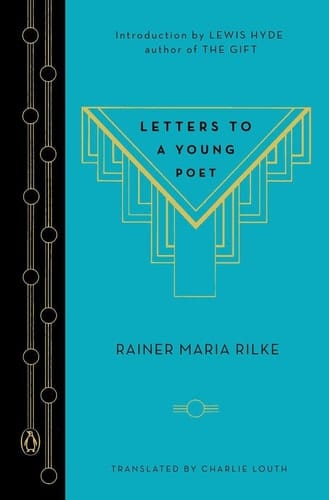
Letters to a Young Poet
About
A gorgeous edition of one of the most beloved classics of the twentieth century, published in celebration of W. W. Norton’s 100th anniversary. This slim volume of letters from the poet and mystic, Rainer Maria Rilke, to a nineteen-year-old cadet and aspiring poet named Franz Xaver Kappus, has touched millions of readers since it was first published in English in 1934. The translator, Mary Dows Herter Norton—a polymath extraordinaire with expertise in music, literature, and science, and who, along with her husband, William Warder Norton, founded the company that bears his name—played a crucial role in elevating Rilke’s reputation in the English-speaking world. This Norton Centenary Edition commemorates Norton, known as “Polly” to friends and colleagues, and the 100th anniversary of the publishing company she co-founded. An admiring foreword by Damion Searls—himself a recent translator of Rilke’s Letters—celebrates Polly’s stylistic achievement, and an afterword by Norton’s President, Julia A. Reidhead, honors her commitment to maintaining W. W. Norton & Company’s independence. This handsome new edition of a beloved classic brings Rilke’s enduring wisdom about life, love, and art to a new generation, in the translation that first introduced him to the English-speaking world.
Unchaptered
p. 8
You are looking to the outside, and that above all you should not be doing now. Nobody can advise you and help you, nobody. There is only one way. Go into yourself.
p. 10
Then assume this fate and bear it, its burden and its greatness, without ever asking after the rewards that may come from outside. For he who creates must be a world of his own and find everything within himself and in the natural world that he has elected to follow.
p. 11
…go through your development quietly and seriously; you cannot disrupt it more than by looking outwards and expecting answers from without to questions that only your innermost instinct in your quietest moments will perhaps be able to answer.
p. 18
…read as little as possible in the way of aesthetics and criticism—it will either be partisan views, fossilized and made meaningless in its lifeless rigidity, or it will be neat wordplay, where one opinion will triumph one day and the opposite the next. Works of art are infinitely solitary and nothing is less likely to reach them than criticism. Only love can grasp them and hold them and do them justice.
p. 19
These things cannot be measured by time, a year has no meaning, and ten years are nothing. To be an artist means: not to calculate and count; to grow and ripen like a tree which does not hurry the flow of its sap and stands at ease in the spring gales without fearing that no summer may follow. It will come. But it comes only to those who are patient, who are simply there in their vast, quiet tranquillity, as if eternity lay before them. It is a lesson I learn every day amid hardships I am thankful for: patience is all!
p. 19
…trust yourself and your instincts; even if you go wrong in your judgment, the natural growth of your inner life will gradually, over time, lead you to other insights. Allow your verdicts their own quiet untroubled development which like all progress must come from deep within and cannot be forced or accelerated. Everything must be carried to term before it is born. To let every impression and the germ of every feeling come to completion inside, in the dark, in the unsayable, the unconscious, in what is unattainable to one’s own intellect, and to wait with deep humility and patience for the hour when a new clarity is delivered: that alone is to live as an artist, in the understanding and in one’s creative work.
p. 21
The letters to friends are less reticent, however, and one of their surprises is how often Rilke speaks of being anxious and afraid. Afraid of what? Afraid, I think, that he might never become his own person.
p. 22
He lived in fear of two false fates: either that he might end up as lost as the ragged poor who had surrounded him in Paris or else that he might succumb to the safe but numbing comforts of convention.
p. 23
This trick of reversal, of turning negatives into positives, became a regular part of Rilke’s working method. Anxiety, fear, sadness, doubt: there is no human emotion that cannot be upended and put into service.
p. 24
If you hold close to nature, to what is simple in it, to the small things people hardly see and which all of a sudden can become great and immeasurable; if you have this love for what is slight, and quite unassumingly, as a servant, seek to win the confidence of what seems poor—then everything will grow easier, more unified and somehow more conciliatory, not perhaps in the intellect, which, amazed, remains a step behind, but in your deepest consciousness, watchfulness and knowledge. You are so young, all still lies ahead of you, and I should like to ask you, as best I can, dear Sir, to be patient towards all that is unresolved in your heart and to try to love the questions themselves like locked rooms, like books written in a foreign tongue. Do not now strive to uncover answers: they cannot be given you because you have not been able to live them. And what matters is to live everything. Live the questions for now. Perhaps then you will gradually, without noticing it, live your way into the answer, one distant day in the future.
p. 26
…in solitude (after a few days) the mind that weighs the work withdraws and I simply enter my material on its own terms. I may later find that what I have written is junk or that it is gold, but such labels have little currency in the confines of solitude.
p. 26
Mechanical time makes haste, as it were, but haste dissolves in solitude. In solitude we feel ‘as if eternity lay before’ us.
p. 28
…take pleasure in your growth, in which no one can accompany you, and be kind-hearted towards those you leave behind, and be assured and gentle with them and do not plague them with your doubts or frighten them with your confidence or your joyfulness, which they cannot understand. Look for some kind of simple and loyal way of being together with them which does not necessarily have to alter however much you may change; love in them a form of life different from your own and show understanding for the older ones who fear precisely the solitude in which you trust.
p. 31
…I prefer not to write letters when I’m travelling because letter-writing requires more of me than just the basic wherewithal: some quiet and time on my own and a moment when I feel relatively at home.
p. 36
What goes on in your innermost being is worth all your love, this is what you must work on however you can and not waste too much time and too much energy on clarifying your attitude to other people.
p. 42
People have tended (with the help of conventions) to resolve everything in the direction of easiness, of the light, and on the lightest side of the light; but it is clear that we must hold to the heavy, the difficult. All living things do this, everything in nature grows and defends itself according to its kind and is a distinct creature from out of its own resources, strives to be so at any cost and in the face of all resistance. We know little, but that we must hold fast to what is difficult is a certainty that will never forsake us. It is good to be alone, for solitude is difficult; that something is difficult should be one more reason to do it.
p. 47
One day (there are already reliable signs which speak for it and which begin to spread their light, especially in the northern countries), one day there will be girls and women whose name will no longer just signify the opposite of the male but something in their own right, something which does not make one thing of any supplement or limit but only of life and existence: the female human being.
p. 55
But only someone who is ready for anything and rules nothing out, not even the most enigmatic things, will experience the relationship with another as a living thing and will himself live his own existence to the full.
p. 55
That human beings have been cowardly in this regard has done life endless harm; the experiences we describe as ‘apparitions,’ the entire so-called ‘spiritual world,’ death, all those things so closely akin to us have by our daily rejection of them been forced so far out of our lives that the sense with which we might apprehend them have atrophied.
p. 56
We have no reason to be mistrustful of our world, for it is not against us. If it holds terrors they are our terrors, if it has its abysses these abysses belong to us, if there are dangers then we must try to love them. And if we only organize our life according to the principle which teaches us always to hold to what is difficult, then what now still appears most foreign will become our most intimate and most reliable experience. How can we forget those ancient myths found at the beginnings of all peoples? The myths about the dragons who at the last moment turn into princesses? Perhaps all the dragons in our lives are princesses, only waiting for the day when they will see us handsome and brave? Perhaps everything terrifying is deep down a helpless thing that needs our help.
p. 57
Why should you want to exclude from your life all unsettling, all pain, all depression of spirit, when you don’t know what work it is these states are performing within you?
p. 57
Do not watch yourself too closely. Do not draw over-rapid conclusions from what is happening to you. Simply let it happen. Otherwise you will too readily find yourself looking on your past, which is of course not uninvolved with everything that is going on in you now, reproachfully (that is, moralistically). But what now affects you from among the divagations, desires and longings of your boyhood is not what you will recall and condemn.
p. 71
It is a monstrous act of violence to begin something. I cannot begin. I’m simply jumping over what ought to be the beginning. Nothing is as powerful as silence. Were we not all of us born into talk, it would never have been broken.
“Often though a question’s gravity
But I ask you to consider whether these great unhappinesses did not rather pass through you. Whether much within you has not changed, whether somewhere, in some part of your being, you were not transformed while you were unhappy?
He [Rilke] often approached the never-quite-superable task of keeping his correspondence up to date as a way of getting into writing, a way of putting something off and stealing up on it at the same time. The form of the letter, a text addressed to a specific person with no particular constraints, was clearly one which suited him…
Highlights
“Often though a question’s gravity
cuts across my path. I seem to shrink,
pass coldly on as if beside a lake
whose waters are too vast for me to measure.”