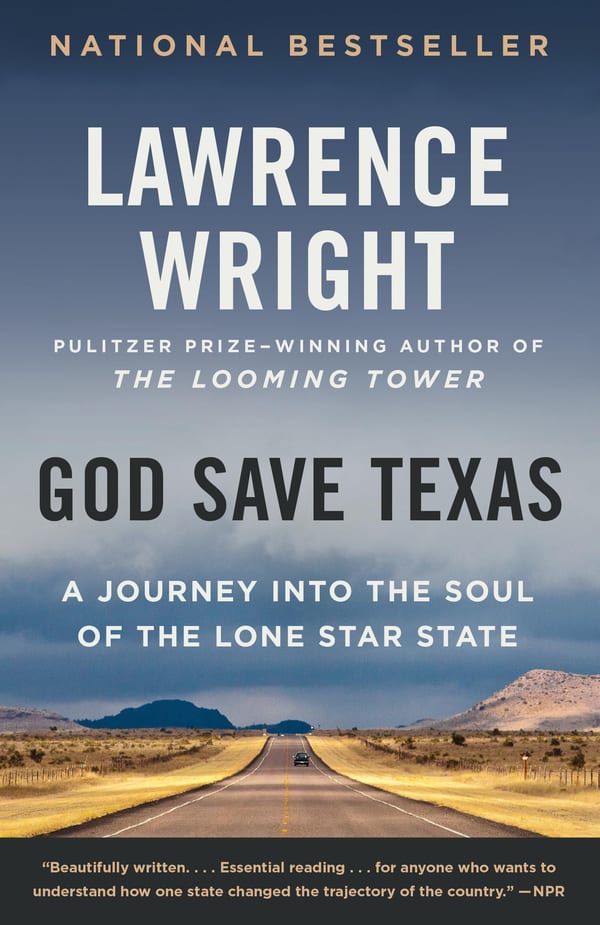
God Save Texas
About
NATIONAL BOOK CRITICS CIRCLE AWARD FINALIST • The Pulitzer Prize-winning author of The Looming Tower—and a Texas native—takes us on a journey through the most controversial state in America. • “Beautifully written…. Essential reading [for] anyone who wants to understand how one state changed the trajectory of the country.” —NPR
The inspiration for the HBO Original documentary trilogy God Save Texas streaming on Max
Texas is a red state, but the cities are blue and among the most diverse in the nation. Oil is still king, but Texas now leads California in technology exports. Low taxes and minimal regulation have produced extraordinary growth, but also striking income disparities. Texas looks a lot like the America that Donald Trump wants to create.
Bringing together the historical and the contemporary, the political and the personal, Texas native Lawrence Wright gives us a colorful, wide-ranging portrait of a state that not only reflects our country as it is, but as it may become—and shows how the battle for Texas’s soul encompasses us all.
Highlights
Riding on top of the old stereotypes are new ones—hipsters, computer gurus, musicians, video-game tycoons, and a widening artistic class that has reshaped the state’s image and the way we think of ourselves.
I’ve seen the same thing happen to people who come from other societies with a strong cultural imprint; they reverse the image. But being the opposite of what you were is not the same as being somebody new. As soon as the doors to liberation opened, I fled. I wanted to be someplace open, tolerant, cosmopolitan, and beautiful. I thought I would never come back. I turned into that pitiable figure, a self-hating Texan.
A great culture is aware of the world beyond but is constantly turning back on itself, searching for its roots, examining its direction, criticizing and talking to itself—in short, taking itself seriously.
The downside of the machismo is that we turn away from the feminine side of our nature. It is evident in the indifference to beauty and a sort of loathing for compassion, as manifested in our schools, our prisons, our mental health facilities, and our lack of concern for the environment.
One can drive across Texas and be in two different states at the same time: AM Texas and FM Texas. FM Texas is the silky voice of city dwellers in the kingdom of NPR. It is progressive, blue, reasonable, secular, and smug—almost like California. AM Texas speaks to the suburbs and the rural areas—Trumpland. It’s endless bluster and endless ads. Paranoia and piety are the main items on the menu.
The fact that turnout is chronically lower in Texas has less to do with race than it does with its disproportionate number of young, poor, and uneducated citizens. As Wendy Davis observed, “Texas is not a red state. It’s a nonvoting blue state.”
I have always believed that memories have to burn a little to make an enduring place in your heart.