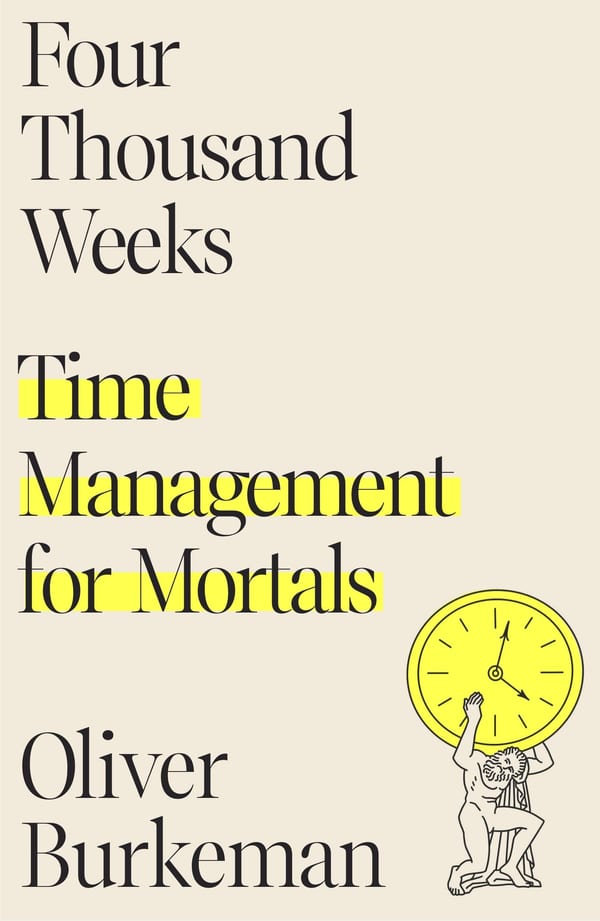
Four Thousand Weeks
About
AN INSTANT NEW YORK TIMES BESTSELLER
“Provocative and appealing … well worth your extremely limited time.” —Barbara Spindel, The Wall Street Journal
The average human lifespan is absurdly, insultingly brief. Assuming you live to be eighty, you have just over four thousand weeks.
Nobody needs telling there isn’t enough time. We’re obsessed with our lengthening to-do lists, our overfilled inboxes, work-life balance, and the ceaseless battle against distraction; and we’re deluged with advice on becoming more productive and efficient, and “life hacks” to optimize our days. But such techniques often end up making things worse. The sense of anxious hurry grows more intense, and still the most meaningful parts of life seem to lie just beyond the horizon. Still, we rarely make the connection between our daily struggles with time and the ultimate time management problem: the challenge of how best to use our four thousand weeks.
Drawing on the insights of both ancient and contemporary philosophers, psychologists, and spiritual teachers, Oliver Burkeman delivers an entertaining, humorous, practical, and ultimately profound guide to time and time management. Rejecting the futile modern fixation on “getting everything done,” Four Thousand Weeks introduces readers to tools for constructing a meaningful life by embracing finitude, showing how many of the unhelpful ways we’ve come to think about time aren’t inescapable, unchanging truths, but choices we’ve made as individuals and as a society—and that we could do things differently.
Unchaptered
p. 3
The average human lifespan is absurdly, terrifyingly, insultingly short… Assuming you live to be eighty, you’ll have had about four thousand weeks.
p. 4
…the defining problem of human existence: we’ve been granted the mental capacities to make almost infinitely ambitious plans, yet practically no time at all to put them into action.
p. 6
How can you be sure that people feel so busy? It’s like the line about how to know whether someone’s a vegan: don’t worry, they’ll tell you.
p. 6
Recently, as the gig economy has grown, busyness has been rebranded “hustle”—relentless work not as a burden to be endured but as an exhilarating lifestyle choice, worth boasting about on social media.
p. 7
It’s hard to imagine a crueler arrangement: not only are our four thousand weeks constantly running out, but the fewer of them we have left, the faster we seem to lose them.
p. 7
Even some of the very worst aspects of our era—like our viciously hyperpartisan politics and terrorists radicalized via YouTube videos—can be explained, in a roundabout way, by the same underlying facts concerning life’s brevity. It’s because our time and attention are so limited, and therefore valuable, that social media companies are incentivized to grab as much of them as they can, by any means necessary—which is why they show users material guaranteed to drive them into a rage, instead of the more boring and accurate stuff.
p. 8
…it felt as though the future had been put on hold, leaving many of us stuck, in the words of one psychiatrist, “in a new kind of everlasting present”—an anxious limbo of social media scrolling and desultory Zoom calls and insomnia, in which it felt impossible to make meaningful plans, or even to clearly picture life beyond the end of next week.
p. 9
The problem isn’t exactly that these techniques and products don’t work. It’s that they do work—in the sense that you’ll get more done, race to more meetings, ferry your kids to more after-school activities, generate more profit for your employer—and yet, paradoxically, you only feel busier, more anxious, and somehow emptier as a result. In the modern world, the American anthropologist Edward T. Hall once pointed out, time feels like an unstoppable conveyor belt, bringing us new tasks as fast as we can dispatch the old ones; and becoming “more productive” just seems to cause the belt to speed up.
p. 10
Consider all the technology intended to help us gain the upper hand over time: by any sane logic, in a world with dishwashers, microwaves, and jet engines, time out to feel more expansive and abundant, thanks to all the hours freed up. But this is nobody’s actual experience. Instead, life accelerates, and everyone grows more impatient. It’s somehow vastly more aggravating to wait two minutes for the microwave than two hours for the oven—or ten seconds for a slow-loading web page versus three days to receive the same information by mail.
p. 11
Keynes was wrong. It turns out that when people make enough money to meet their needs, they just find new things to need and new lifestyles to aspire to; they never quite manage to keep up with the Joneses, because whenever they’re in danger of getting close, they nominate new and better Joneses with whom to try to keep up. As a result, they work harder and harder, and soon busyness becomes an emblem of prestige.
p. 12
And this feeling of wrongness is only exacerbated by our attempts to become more productive, which seems to have the effect of pushing the genuinely important stuff ever further over the horizon. Our days are spent trying to “get through” tasks, in order to get them “out of the way,” with the result that we live mentally in the future, waiting for when we’ll finally get around to what really matters—and worrying, in the meantime, that we don’t measure up, that we might lack the drive or stamina to keep pace with the speed at which life now seems to move. “The spirit of the times is one of joyless urgency,” writes the essayist Marilynne Robinson, who observes that many of us spend our lives “preparing ourselves and our children to be means to inscrutable ends that are utterly not our own.”
p. 13
Nobody in the history of humanity has ever achieved “work-life balance,” whatever that might be, and you certainly won’t get there by copying the “six things successful people do before 7:00 a.m.”
On almost any meaningful timescale, as the contemporary philosopher Thomas Nagel has written, “we will all be dead any minute.”
The world is bursting with wonder, and yet it’s the rare productivity guru who seems to have considered the possibility that the ultimate point of all our frenetic doing might be to experience more of that wonder…