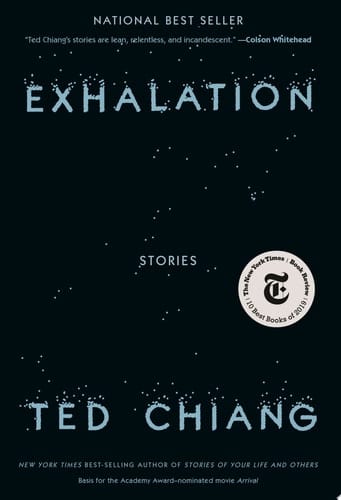
Exhalation
About
NATIONAL BESTSELLER • ONE OF THE NEW YORK TIMES BEST BOOKS OF THE YEAR • Nine stunningly original, provocative, and poignant stories—two published for the very first time—all from the mind of the incomparable author of Stories of Your Life and Others Tackling some of humanity’s oldest questions along with new quandaries only he could imagine, these stories will change the way you think, feel, and see the world. They are Ted Chiang at his best: profound, sympathetic, revelatory. Ted Chiang tackles some of humanity’s oldest questions along with new quandaries only he could imagine. In “The Merchant and the Alchemist’s Gate,” a portal through time forces a fabric seller in ancient Baghdad to grapple with past mistakes and second chances. In “Exhalation,” an alien scientist makes a shocking discovery with ramifications that are literally universal. In “Anxiety Is the Dizziness of Freedom,” the ability to glimpse into alternate universes necessitates a radically new examination of the concepts of choice and free will.
Unchaptered
p. 7
He offered an explanation, speaking of his search for tiny pores in the skin of reality, like the holes that worms bore into wood, and how upon finding one he was able to expand and stretch it the way a glassblower turns a dollop of molten glass into a long-necked pipe, and how he then allowed time to flow like water at one mouth while causing it to thicken like syrup at the other.
p. 11
“No, because I heeded my older self’s warning. Do not forget, you and I are one; every circumstance that befalls you once befell me.”
p. 29
…men of experience say, “Four things do not come back: the spoken word, the sped arrow, the past life, and the neglected opportunity…“
p. 31
“Coincidence and intention are two sides of a tapestry, my lord. You may find one more agreeable to look at, but you cannot say one is true and the other is false.”
p. 35
…past and future are the same, and we cannot change either, only know them more fully… If our lives are tales that Allah tells, then we are the audience as well as the players, and it is by living these tales that we receive their lessons.
p. 36
Nothing erases the past. There is repentance, there is atonement, and there is forgiveness. That is all, but that is enough.
p. 53
The universe began as an enormous breath being held. Who knows why, but whatever the reason, I am glad that it did, because I owe my existence to that fact. All my desires and ruminations are no more and no less than eddy currents generated by the gradual exhalation of our universe. And until this great exhalation is finished, my thoughts live on.
p. 55
It cheers me to imagine that the air that once powered me could power others, to believe that the breath that enables me to engrave these words could one day flow through someone else’s body. I do not delude myself into thinking that this would be a way for me to live again, because I am not that air, I am the pattern that it assumed, temporarily. The pattern that is me, the patterns that are the entire world in which I live, would be gone.
p. 106
…minds don’t grow the way weeds do, flourishing under indifferent attention; otherwise all children in orphanages would thrive. For a mind to even approach its full potential, it needs cultivation by other minds.
p. 163
…there are no shortcuts; if you want to create the common sense that comes from twenty years of being in the world, you need to devote twenty years to the task. You can’t assemble an equivalent collection of heuristics in less tie; experience is algorithmically incompressible.
p. 196
You could not find the places where words began and ended by listening. The sounds a person made while speaking were as smooth and unbroken as the hide of a goat’s leg, but the words were like the bones underneath the meat, and the space between them was the joint where you’d cut if you wanted to separate it into pieces. By leaving spaces when he wrote, Moseby was ==making visible the bones== in what he said.
p. 198
“Forgive and forget” goes the expression, and for our idealized magnanimous selves, that is all you needed. But for our actual selves the relationship between those two actions isn’t so straightforward. In most cases we have to forget a little bit before we can forgive; when we no longer experience the pain as fresh, the insult is easier to forgive, which in turn makes it less memorable, and so on. It’s this psychological feedback loop that makes initially infuriating offenses seem pardonable in the mirror of hindsight.
p. 205
… writing was not just a way to record what someone said; it could help you decide what you would say before you said it. And words were not just the pieces of speaking; they were the pieces of thinking. When you wrote them down, you could grasp your thoughts like bricks in your hands and push them into different arrangements. Writing let you look at your thoughts in a way you couldn’t if you were just talking, and having seen them, you could improve them, make them stronger and more elaborate.
p. 206
… we’ve historically resisted [technological supplements] when it comes to episodic memory; few people have ever kept as many diaries or photo albums as they did ordinary books… I also wonder if another reason is that, subconsciously, we regarded our episodic memories as such an integral part of our identities that we were reluctant to externalize them, to relegate them to books on a shelf or files on a computer.
p. 206
How will it change a person’s conception of herself when she’s only seen her past through the unblinking eye of a video camera? Just as there’s a feedback loop in softening harsh memories, there’s also one at work in the romanticization of childhood memories, and disrupting that process will have consequences.
p. 207
It seems to me that continuous video of my entire childhood would be full of facts but devoid of feeling, simply because cameras couldn’t capture the emotional dimension of events.
p. 207
Regarding the role of truth in autobiography, the critic Roy Pascal wrote, “On the one side are the truths of fact, on the other the truth of the writer’s feeling, and where the two coincide cannot be decided by any outside authority in advance.”
p. 208
People are made of stories. Our memories are not the impartial accumulation of every second we’ve lived; they’re the narrative that we assembled out of selected moments.
p. 209
…a perfect memory couldn’t be a narrative any more than unedited security-cam footage could be a feature film.
p. 226
We don’t normally think of it as such, but writing is a technology, which means that a literate person is someone whose thought processes are technologically mediated. We became cognitive cyborgs as soon as we became fluent readers, and the consequences of that were profound.
p. 227
Anthropologists will tell you that oral cultures understand the past differently; for them, their histories don’t need to be accurate so much as they need to validate the community’s understanding of itself… Right now each of us is a private oral culture. We rewrite our pasts to suit our needs and support the story we tell about ourselves.
p. 229
What digital memory will do is change those stories from fabulations that emphasize our best acts and elide our worst, into ones that—I hope—acknowledge our fallibility and make us less judgmental about the fallibility of others.