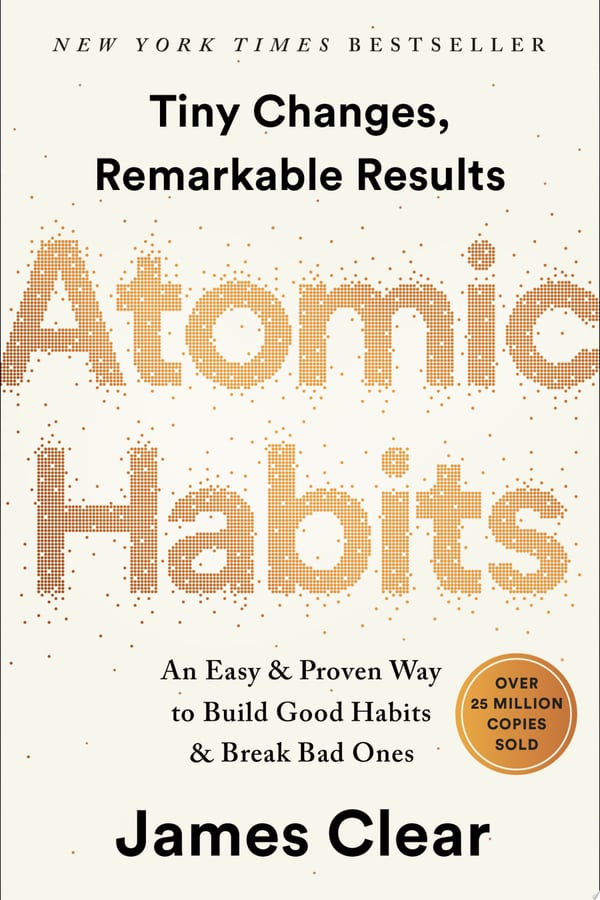
Atomic Habits
About
The #1 New York Times bestseller. Over 25 million copies sold! Translated into 60+ languages!
Tiny Changes, Remarkable Results
No matter your goals, Atomic Habits offers a proven framework for improving—every day. James Clear, one of the world’s leading experts on habit formation, reveals practical strategies that will teach you exactly how to form good habits, break bad ones, and master the tiny behaviors that lead to remarkable results.
If you’re having trouble changing your habits, the problem isn’t you. The problem is your system. Bad habits repeat themselves again and again not because you don’t want to change, but because you have the wrong system for change. You do not rise to the level of your goals. You fall to the level of your systems. Here, you’ll get a proven system that can take you to new heights.
Clear is known for his ability to distill complex topics into simple behaviors that can be easily applied to daily life and work. Here, he draws on the most proven ideas from biology, psychology, and neuroscience to create an easy-to-understand guide for making good habits inevitable and bad habits impossible. Along the way, readers will be inspired and entertained with true stories from Olympic gold medalists, award-winning artists, business leaders, life-saving physicians, and star comedians who have used the science of small habits to master their craft and vault to the top of their field.
Learn how to: make time for new habits (even when life gets crazy);overcome a lack of motivation and willpower;design your environment to make success easier;get back on track when you fall off course;…and much more.
Atomic Habits will reshape the way you think about progress and success, and give you the tools and strategies you need to transform your habits—whether you are a team looking to win a championship, an organization hoping to redefine an industry, or simply an individual who wishes to quit smoking, lose weight, reduce stress, or achieve any other goal.
Unchaptered
p. 25
If successful and unsuccessful people share the same goals, then the goal cannot be what differentiates the winners from the losers.
p. 27
You do not rise to the level of your goals. You fall to the level of your systems. Goals are about the results you want to achieve. Systems are about the processes that lead to those results… Your system is how you test product ideas, hire employees, and run marketing campaigns.
p. 35
The biggest barrier to positive change at any level—individual, team, society—is identity conflict… The word identity was originally derived from the Latin words essentitas, which means being, and identidem, which means repeatedly. Your identity is literally your “repeated beingness.”
p. 73
The Diderot Effect states that obtaining a new possession often creates a spiral of consumption that leads to additional purchases… One of the best ways to build a new habit is to identify a current habit you already do each day and then stack your new behavior on top. This is called habit stacking.
p. 87
Our behavior is not defined by the objects in the environment but by our relationship to them. In fact, this is a useful way to think about the influence of the environment on your behavior. Stop thinking about your environment as filled with objects. Start thinking about it as filled with relationships. Think in terms of how you interact with the spaces around you.
p. 116
We imitate the habits of three groups in particular: the close, the many, and the powerful.
p. 142
It is easy to get bogged down trying to find the optimal plan for change: the fastest way to lose weight, the best program to build muscle, the perfect idea for a side hustle. We are so focused on figuring out the best approach that we never get around to taking action. As Voltaire once wrote, “The best is the enemy of the good.”
p. 143
When preparation becomes a form of procrastination, you need to change something. You don’t want to merely be planning. You want to be practicing.
p. 190
People who are better at delaying gratification have higher SAT scores, lower levels of substance abuse, lower likelihood of obseity, better responses to stress, and superior social skills.
p. 201
The first mistake is never the one that ruins you. It is the spiral of repeated mistakes that follows. Missing once is an accident. Missing twice is the start of a new habit.
p. 203
Goodhart’s law: when a measure becomes a target, it ceases to be a good measure. Measurement is only useful when it guides you and adds context to a larger picture, not when it consumes you. Each number is simply one piece of feedback in the overall system.
p. 223
If you are currently winning, you exploit, exploit, exploit. If you are currently losing, you continue to explore, explore, explore.
p. 224
As you explore different options, there are a series of questions you can ask yourself to continually narrow in on the habits and areas that will be most satisfying to you: What feels like fun to me, but work to others? What makes me lose track of time? Where do I get greater returns than the average person? What comes naturally to me?
p. 225
A good player works hard to win the game everyone else is playing. A great player creates a new game that favors their strengths and avoids their weaknesses.
p. 231
The Goldilocks Rule states that humans experience peak motivation when working on tasks that are right on the edge of their current abilities. Not too hard. Not too easy. Just right.
p. 236
The only way to become excellent is to be endlessly fascinated by doing the same thing over and over. You have to fall in love with boredom.
p. 248
When you cling too tightly to one identity, you become brittle. Lose that thing and you lose yourself.
p. 260
Peace occurs when you don’t turn your observations into problems… Observation without craving is the realization that you do not need to fix anything. Your desires are not running rampant. You do not crave a change in state. Your mind does not generate a problem for you to solve. You’re simply observing and existing.
p. 260
With a big enough why you can overcome any how. Friedrich Nietzsche, the German philosopher and poet, famously wrote, “He who has a why to live for can bear almost any how.”
p. 260
It is the idea of pleasure that we chase… happiness cannot be pursued, it must ensue. Desire is pursued. Pleasure ensues from action.
p. 261
Being curious is better than being smart. Being motivated and curious counts for more than being smart because it leads to action. Being smart will never deliver results on its own because it doesn’t get you to act. It is desire, not intelligence, that prompts behavior. As Naval Ravikant says, “The trick to doing anything is first cultivating a desire for it.”
p. 262
Suffering drives progress. The source of all suffering is the desire for a change in state. This is also the source of all progress. It is wanting more that pushes humanity to seek improvements, develop new technologies, and reach for a higher level. With craving, we are dissatisfied but driven. Without craving, we are satisfied but lack ambition.
Highlights
The only way to become excellent is to be endlessly fascinating by doing the same thing over and over. You have to fall in love with boredom.