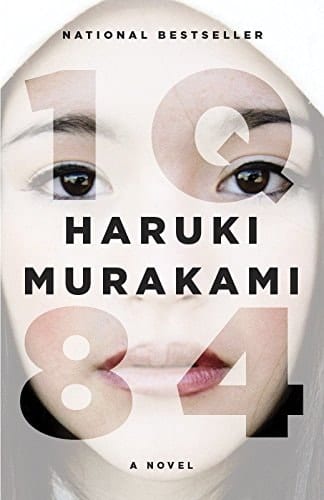
1Q84
About
NATIONAL BESTSELLER • “A tremendous accomplishment. It does every last blessed thing a masterpiece is supposed to—and a few things we never even knew to expect.”—San Francisco Chronicle
“Brilliant … an irresistibly engaging literary fantasy.”—The Washington Post
A Kirkus Reviews Best Fiction Book of the Century
The year is 1984 and the city is Tokyo.
A young woman named Aomame follows a taxi driver’s enigmatic suggestion and begins to notice puzzling discrepancies in the world around her. She has entered, she realizes, a parallel existence, which she calls 1Q84 —“Q is for ‘question mark.’ A world that bears a question.” Meanwhile, an aspiring writer named Tengo takes on a suspect ghostwriting project. He becomes so wrapped up with the work and its unusual author that, soon, his previously placid life begins to come unraveled.
As Aomame’s and Tengo’s narratives converge over the course of this single year, we learn of the profound and tangled connections that bind them ever closer: a beautiful, dyslexic teenage girl with a unique vision; a mysterious religious cult that instigated a shoot-out with the metropolitan police; a reclusive, wealthy dowager who runs a shelter for abused women; a hideously ugly private investigator; a mild-mannered yet ruthlessly efficient bodyguard; and a peculiarly insistent television-fee collector.
A love story, a mystery, a fantasy, a novel of self-discovery, a dystopia to rival George Orwell’s—1Q84 is a striking feat of imagination from one of our most revered contemporary writers.
Unchaptered
p. 79
Smart presidents usually became the targets of assassins, so people with higher-than-average intelligence probably did their best to avoid being elected.
p. 344
Time itself was uniform in composition, but once consumed, it took on a deformed shape. One period of time might be terribly heavy and long, while another could be light and short. Occasionally the order of things could be reversed, and in the worst cases order itself could vanish entirely.
p. 438
You can’t choose how you’re born, but you can choose how you die.
p. 512
A person learns how to love himself through the simple acts of loving and being loved by someone else. Do you understand what I am saying? A person who is incapable of loving another cannot properly love himself.
p. 793
Nobody’s easier to fool, Ushikawa thought, than the person who is convinced that he is right.
p. 868
So he always kept his mouth shut. He kept his ears open and listened closely to whatever anyone else had to say, aiming to learn something from everything he heard. This habit eventually became a useful tool. Through this, he discovered a number of important realities, including this one: most people in the world don’t really use their brains to think. And people who don’t think are the ones who don’t listen to others.